Article
SHARPER communication officer wins Best Oral Presentation Award at International Pandemic Conference 2026
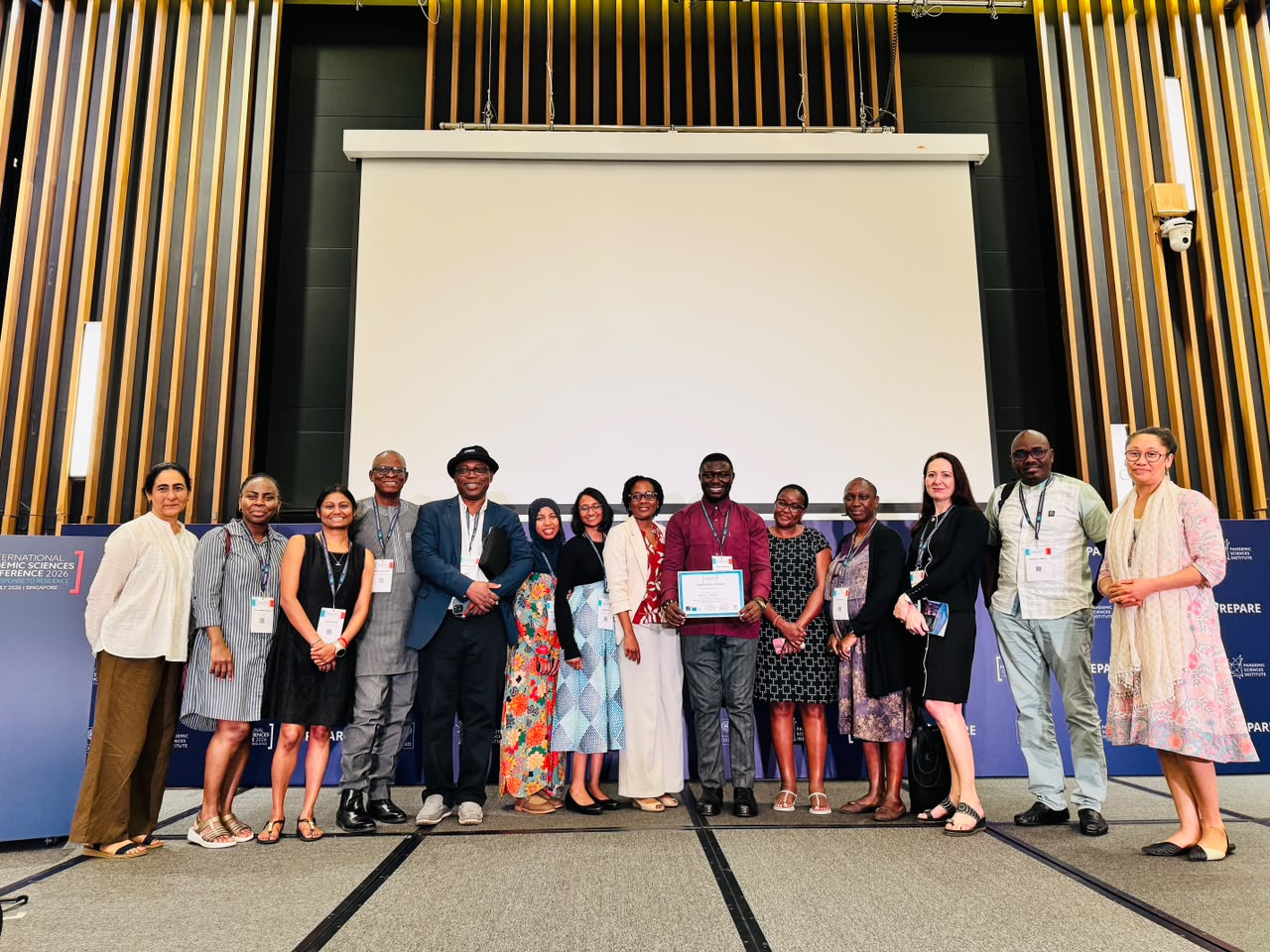
Adams Adeshola, an early-career professional serving as the Communication Officer with the Strengthening Health Systems Capacity for Pandemic Equity and Responsiveness (SHARPER) project, won the Best Oral Presentation Award in the Ethics and Context category at the International Pandemic Sciences Conference in Singapore, held from 1–3 July 2026.
Adeshola’s presentation, titled Decolonising Research Ethics in Africa through Indigenous Language Institutionalisation: A Case Study of the Yoruba Language, was well received not only because of the relevance of the topic but also for his confident delivery. He argued that the informed consent process is often flawed, particularly when research involves complex medical terminology. He recommended that the use of indigenous African languages, such as Yoruba, which is widely spoken in south-west Nigeria, can improve participants’ understanding of research, foster trust between researchers and communities, and strengthen public engagement during disease outbreaks and pandemics. His presentation challenged conventional approaches to research ethics by demonstrating that effective communication is not merely a supporting component of public health but a critical pillar of ethical research, community participation, and pandemic preparedness.
Adeshola’s journey to the international stage began in January 2026 when the Pandemic Sciences Institute issued a call for abstracts for its annual conference. He submitted an abstract that was selected for oral presentation, and a bursary provided by the organisers enabled him to participate in the global event.
A graduate of the University of Ibadan, Adeshola holds a master’s degree in Linguistics and Languages. As SHARPER’s Communication Officer, he attended the conference to reinforce the project’s commitment to promoting ethical and community-centred research in Africa. His recognition marks a significant milestone for interdisciplinary scholarship, highlighting the growing importance of communication and the humanities in shaping research ethics and strengthening pandemic preparedness.
The three-day conference attracted leading researchers, policymakers, public health professionals and innovators from around the world to discuss some of the most pressing issues in pandemic sciences. Discussions covered a wide range of thematic areas, including Ethics and Context, Data, Analytics and Artificial Intelligence, Vaccines and Immunology, Diagnostics and Treatment, Pathogen Biology and Emerging Threats, and Policy and Governance.
Reflecting on receiving the award, Adeshola said:
“As the award presentation session was about to begin, I had taken out my phone simply to record the moment for those who would be recognised. So, when I heard my name called, I was overwhelmed with gratitude. To me, this award means far more than recognition for a presentation. It reaffirms my belief that ‘your background should never limit your future.’
As someone from the humanities, I know many young Africans believe that global health is reserved for those in the biomedical sciences. This experience, however, proves otherwise. Receiving recognition on a global stage affirms that communication, language, and other fields are not peripheral to global health; they are essential to building trust, strengthening research ethics, and improving pandemic preparedness. This award gives me even more confidence in the path I have chosen and inspires me to continue producing research that connects science with society. Above all, I hope it inspires other young people, especially those in the humanities, to believe that their voices matter and that they, too, belong on the global stage.”
Written by Prof Ademola Ajuwon, Principal Investigator of the SHARPER Consortium

